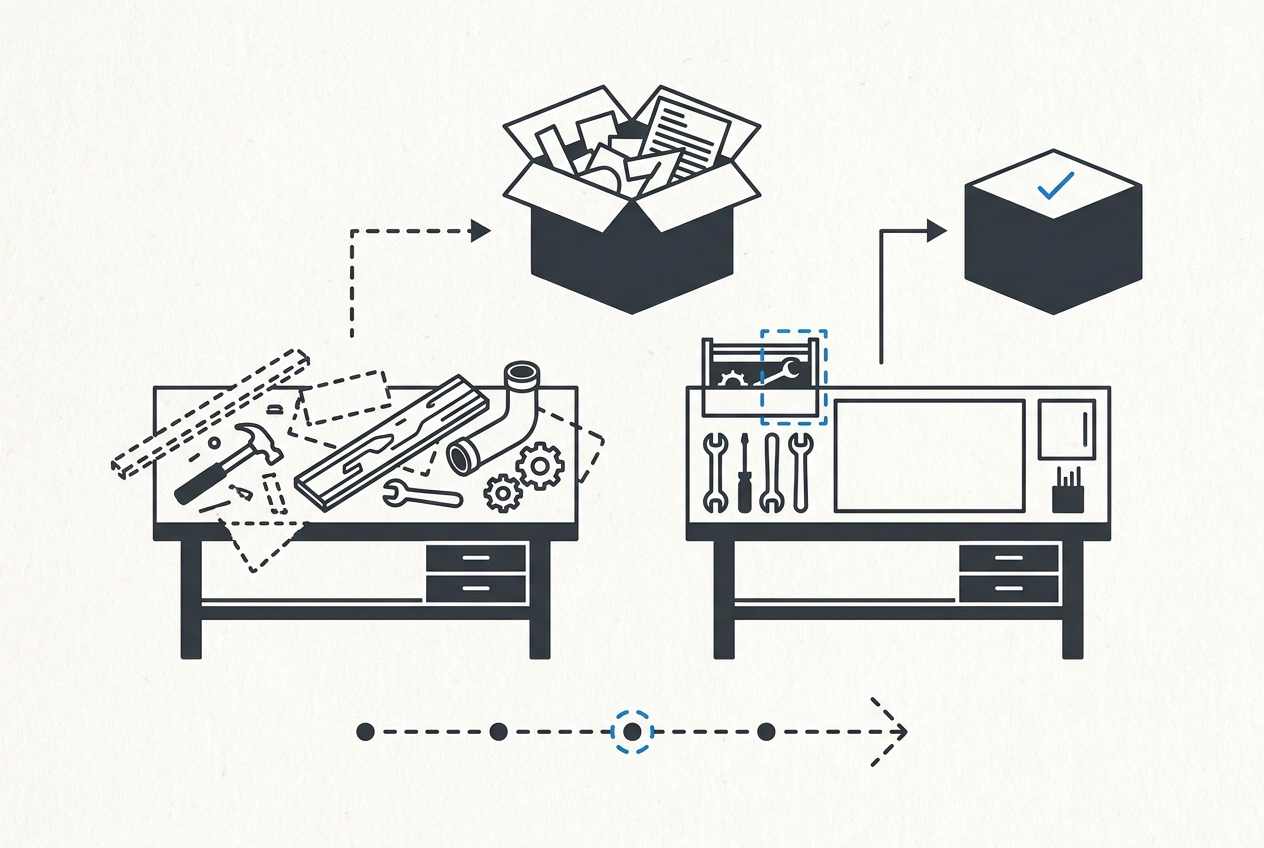
Most of the work happening on a job site right now is not actually moving the job forward. Studies on field construction activity suggest that only about 10% of what crews do on a typical day adds real value. The rest is waiting, moving materials, fixing mistakes, or working around problems that should have been solved before anyone showed up. That is a hard number to sit with, but it is also a useful one.
Lean is one of the better-known process improvement methodologies out there, and most people assume it belongs in car factories, not trade shops. That assumption is worth questioning. The five principles behind Lean are not complicated, and they do not require special software, a consultant, or a team of managers with clipboards. They require honest answers to basic questions about how your shop actually runs.
This post walks through each of the five Lean principles in plain terms, translated for trade contractors who have never read a word about Lean theory. By the end, you will have a practical way to look at your own work and spot exactly where time and money are quietly walking out the door.
Why a Factory Idea Has Anything to Do With Your Shop
Lean was built for factory floors with fixed production lines and predictable workflows. A trade shop looks nothing like that. Your job site changes every week, materials don't always show up on time, and no two jobs are identical.
So why does any of this apply to you?
Because the problems Lean was designed to fix are not factory problems. They are work problems. Waiting on materials, redoing something not done right the first time, a crew standing around at job start because nobody confirmed site access the day before. Those happen in every shop, on every kind of job.
Those numbers from the opening -- 10% value-adding, 50-75% pure waste -- come from CII's lean construction research and they apply as much to a five-person trade shop as to a large site.
The honest caveat: Lean principles need real translation for trade work, not a copy-paste from a manufacturing textbook. You don't have a Toyota-scale supply chain and your production environment isn't fixed. But here's what you do control: crew scheduling, material staging, how rework gets handled, and how callbacks get prevented. That covers most of what actually drives your costs. As any shop owner who has worked through thin margins without a cushion for error already knows, there isn't much room for wasted steps.
This piece walks through all five principles using trade-shop language because you don't need to know what a value stream map is to run a tighter shop.
Principle 1: Define Value from the Customer's Point of View
Starting with principle one means asking a deceptively simple question: what is the customer actually paying for?
In Lean terms, value is anything the customer is willing to pay for and nothing else. Not the second trip to the supply house because the first order was short. Not the hour a tech spent searching the truck for a part that wasn't there. Not the callback to fix something that should have been right the first time. Those costs are real, but the customer didn't ask for them and wouldn't choose to fund them.
For a trade shop, value is narrow: the finished, working installation or repair the customer called about. Everything else, the prep, the re-runs, the administrative back-and-forth, is overhead the shop absorbs.
A practical test: ask what a customer would cross off the invoice if they had the chance. A mid-job parts run they assumed was already handled? They'd cut it. A return visit to fix a detail missed on the first pass? They'd cut that too. Three days of silence waiting for a return call? Definitely cut.
Most shops have never asked that question out loud. Which means they're pricing jobs based on how their process currently runs, including its inefficiencies, and quietly eating the cost of waste in their margins rather than fixing the waste itself.
That's why this principle comes first. Without that anchor, you're just rearranging a process you haven't defined yet.
No software needed here. Just an honest conversation between the owner and whoever runs the jobs, using the last few jobs as the material.
Principle 2: Map the Steps That Deliver That Value (and Cut the Rest)
Once you know what your customer is actually paying for, the next question is straightforward: what steps does it take to deliver that, and which ones are slowing you down?
In Lean language, the full sequence from first call to final invoice is called the value stream. It just means tracing what actually happens on a job versus what should happen.
A simple way to do this: walk a recent job backward. The customer called. You estimated. Materials were ordered. The crew was scheduled. Work was done. The invoice went out. At each step, ask: where did time get lost, something get redone, or the next step have to wait?
The bottlenecks tend to cluster in the same places across most trade shops.
Estimates built from memory instead of real job history, so the bid doesn't reflect what the work actually costs
Materials ordered the morning of a job instead of the day before, so the crew waits at job start
Crew dispatched before anyone confirmed the site was ready or access was arranged
You don't need a flowchart on a whiteboard to find these problems. Sit down with a crew leader and walk through the last three jobs out loud. The same friction points will come up every time. That conversation is a legitimate process improvement technique, not a shortcut around one.
The goal is not a perfect process map. It's identifying the two or three steps that cause the most delay, rework, or cost overrun on a regular basis.
If your shop already tracks job costs by phase, you may not even need that conversation first. Margin loss by task shows up in the numbers before anyone puts a name to the problem. Shops that don't track at that level often find out a job slipped through the cracks only after the fact, with no clear record of where the cost went.
Principle 3: Make the Work Flow Without Interruptions
Once you've mapped the steps, the next question is whether work actually moves through them without stopping.
Flow means exactly that: one step finishes, the next one starts. No crew sitting in the driveway waiting on materials. No invoice parked in a draft folder because nobody logged the hours. No bid stalled because the last job's actual numbers exist only in someone's head.
Idle crew time is one of the most direct cost drivers in trade work, and it's expensive regardless of whether the job is moving. The labor cost runs whether the wrench is turning or not.
The usual suspects that break flow in a small shop:
Materials not staged, or staged wrong, before the crew arrives
Job handoffs that happen in a text message or a hallway conversation, then get misunderstood
Change orders that don't get written down until billing time, and then become a dispute
Most of these aren't random. They're sequencing problems. The day-before checklist is where this gets fixed: what has to be confirmed, pulled, and ready before the crew leaves the shop in the morning, and who owns that confirmation.
A five-person HVAC shop that stages materials the afternoon before a job and verifies site access by end of day knocks out two of the most common reasons crews stand around at job start. Neither change costs anything; they just require someone to own them before 7 a.m.
The harder issue is that flow problems are mostly invisible to the owner. The crew adapts, works around the gap, and gets the job done. The cost surfaces later as overtime, a callback, or a job that ran two hours past what the bid assumed.
Principle 4: Only Start Work When There Is Demand for It
Flow keeps work moving once a job is in motion. Pull determines whether the job should have started at all.
Pull, in plain terms, means you don't do work ahead of confirmed demand. You don't order materials for three jobs when only one is signed. You don't schedule crew before the estimate is accepted. You don't prep anything for work that hasn't been approved.
In manufacturing, pull prevents an assembly line from producing parts nobody ordered yet. In a trade shop, the same pressure shows up differently: you over-commit resources to jobs that aren't locked in, and then a confirmed job lands at the same time. Now you're short on crew, short on materials, and rushing everything.
A plumbing shop that orders rough-in materials before a customer signs off on a scope change is carrying inventory risk and cash flow exposure for work that may never happen. That's not just a purchasing problem; it's a pull problem. The money is out the door before the job is real.
Pull discipline applies to scheduling too. Booking more crew-days than you can actually staff creates downstream pressure that pushes shops into cut corners and missed details, the same problems flow was supposed to prevent.
This is also where job costing and smart bidding connect directly to process improvement. If you know what a job actually costs based on real history, you can price work accurately and make a clear-eyed decision about whether to take it. Taking underpriced work drains resources from profitable jobs already in progress.
For most small shops, applying pull requires one rule, not a new system: nothing gets ordered or scheduled until a signed agreement or deposit is in hand.
Principle 5: Keep Improving the Process After Every Job
Once pull is working, there's one principle left, and it's the one most shops skip.
Lean's fifth principle is sometimes called "perfection," which sounds like an impossible bar. It isn't. It just means looking at what went wrong or went slowly after each job and making one small fix before the next one starts.
Most shop owners already do a version of this in their heads. You know which crew lead generates callbacks. You know which job type always bleeds hours. You know which supplier ships late every third order. That knowledge is real and hard-won. The problem is that it stays in your head and never becomes a change to how the job runs.
The business process improvement loop at this stage is three questions, asked after a job closes:
What cost more than we bid?
What took longer than expected?
What did we have to redo?
Then decide: one-time problem, or pattern?
As the value-stream mapping step showed, margin loss by task only becomes visible when you're tracking it.
This is also the principle most likely to get skipped, because the next job is already starting before the last one fully closes. The fix is simple: build a short close-out step into every job workflow so the review happens before you move on.
One honest monthly conversation between the owner and a crew leader, comparing what was bid to what actually happened, will do more for your operation than any process improvement seminar.
Where to Start If Your Shop Runs on Spreadsheets and Texts
None of this requires software to begin. It requires honest questions, asked by someone who actually knows the work.
Here is a starting sequence that works on paper, spreadsheets, or anything else you already use. Pick one job type you do repeatedly, a water heater swap, a panel upgrade, a standard HVAC service call. Walk it from first customer contact to final invoice. Write down every step that caused a delay, required a redo, or cost more than you planned for. That list is your entry point into every principle covered in this post.
The limit of memory-based bidding becomes clear fast at this stage. If you have been estimating from gut feel, you do not yet have the data to know whether your flow problems are a minor drag or a serious margin leak. Those are very different problems requiring very different responses, and you cannot tell them apart without real numbers.
A simple post-job comparison of bid hours versus actual hours, on a single job type, run consistently for a few months, will surface the patterns Lean is designed to fix. Spreadsheets can do this. A notebook can do this.
When you are ready to stop re-entering the same numbers by hand, crew&cost is built around exactly this kind of visibility. What it does is capture job costs, build bids from real labor and material history, and track crew and license status, so the data these five principles depend on gets collected during normal work, not as extra homework.
The view here is to fix the process first and add technology second. These five principles are the process check. Pick the path that fits your shop, and let the system support what you find.
A Lean Shop Does Not Look Different -- It Runs Different
None of this requires a ceremony. Work through the five principles honestly on one real job and you will find at least one place where work stopped, cost piled up, or a customer waited for no good reason.
You don't need a consultant, a whiteboard, or new software to start. You need one job, a pen, and a willingness to ask where the time and money actually went.
If only one question sticks, make it Principle 1: what is your customer actually paying for?
A lean shop doesn't look different from the outside. The trucks are the same, the crew is the same, the work is the same. What changes is what happens between the first call and the final invoice, and whether that process is working for the shop or against it.
Conclusion
None of this requires new software or outside help. It requires honesty about where time and money disappear on a typical job. The shops that run well don't have different crews or different tools -- they have a process that is visible, tested, and improving.